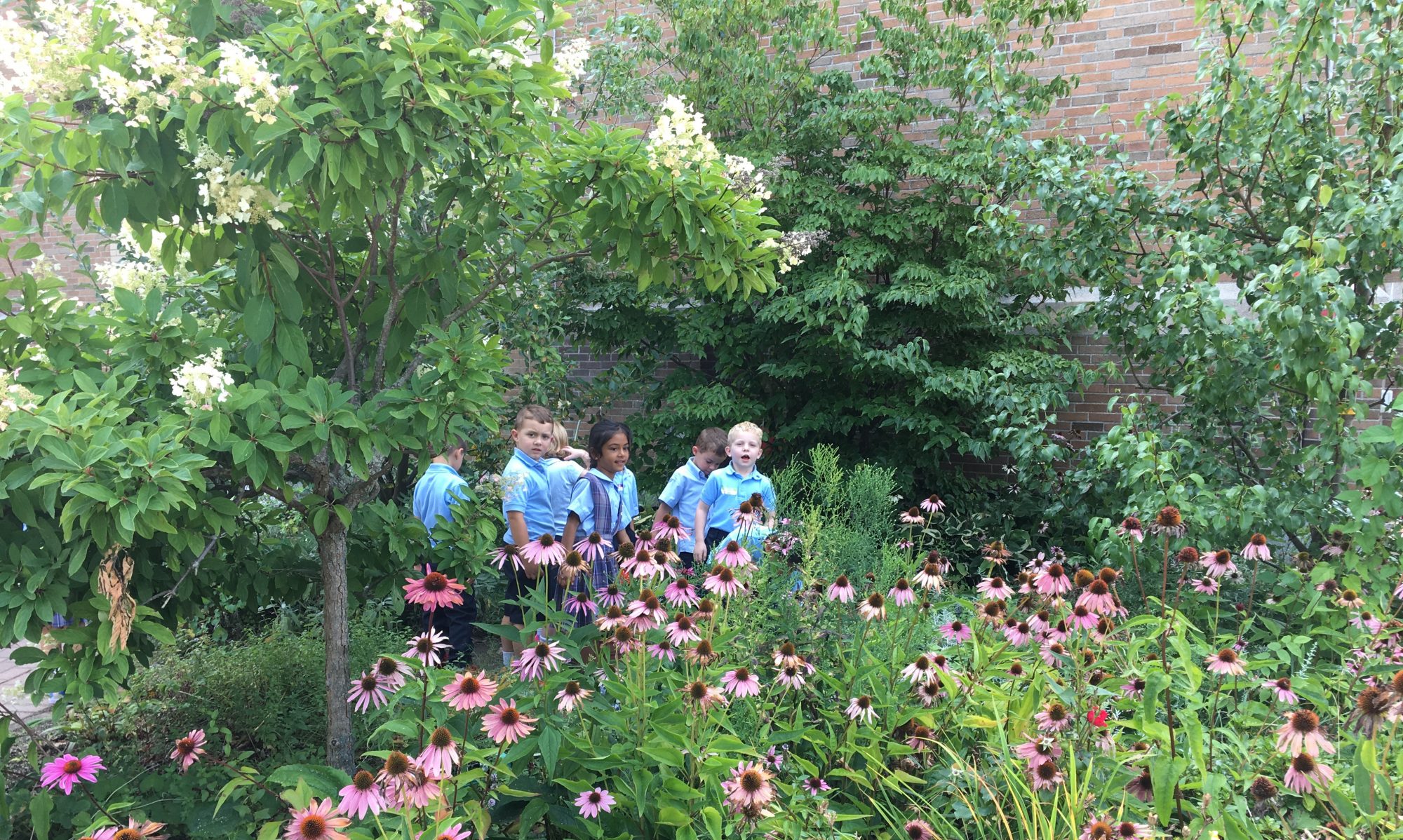
Here’s a link to a webinar on the topic of ‘Gardening with Games and the Arts.’
(Just scroll further down the page for the resources and footnotes associated with this webinar.)
You can also reach it here. https://www.youtube.com/watch?v=X4LJvR0OKFI
“Gardening with Games and the Arts” tries to set forth, in a little over an hour, a lushly illustrated, audio call for an enhanced form of childhood learning within gardens. It points towards young people’s need (and also our need as creative, dedicated teachers) for gardening education that is enjoyable, aesthetically and scientifically grounded, psychologically nourishing, and prosocial. Young people deserve enculturation that nurtures their diverse gifts and their capacities for artistic response, expression, and inspiration. They deserve daily experiences that deliberately contribute to their sense of belonging, security, and agency within Nature, as well as to generous forms of prosociality that place them in beneficial relationship – not only with their fellow humans – but with all the beings large and tiny who comprise the vast Earth Community / the KINdom of Life (to adapt Robin Kimmerer’s terminology) – with all its vast, ancient, and dynamically interwoven evolving systems.
This webinar represents an effort to share the fruits of thirty years of labor (but also joy) struggling to generate educational practices that transmit (and are themselves attuned to) the best contemporary Science. Additionally, the activities are very respectful of Non-modern, ‘Indigenous’ childrearing practices that are often associated with creative art-making. As mentioned above, the activities described here foster physical and aesthetic development and cultivate young people’s Social and Emotional Learning / SEL. Youngsters’ sense of well-being as valued members of their social groups is often fostered through athletic, dramatic, child-directed out-door games (competitive and /or cooperative) and their sense of self-worth as creative participants in real-time, real-place community with one another and the amazing and venerable beings & processes that constitute Life on this precious planet.
Specific Online References
https://evolvingbeauty.org/a-draft-of-the-activities-collection-circling-the-sun-racing-the-wind/
https://nhfarmtoschool.org/indigenous-harvest-calendar/
https://greenwriterspress.com/book/circling-the-sun-racing-the-wind/
https://evolvingbeauty.org/circling-the-sun-racing-the-wind-little-songs-and-chants/
https://fore.yale.edu/event/Yale-University-Online-Classes-Journey-Universe-Story-Our-Times or https://www.journeyoftheuniverse.org
https://evolvingbeauty.org/hummingbirds-to-fly/
https://evolvingbeauty.org/a-grasshopper-pet-to-assemble/
https://www.weforum.org/agenda/2019/09/children-are-forgetting-the-names-for-plants-and-animals/
https://www.sharingnature.com/owls-and-crows.html
Barbara Jaun-Holderegger, Hans-Joachim Lehnert & Petra Lindemann-Matthies (2022). Knowledge and perception of common local wild plant and animal species by children and their teachers – a case study from Switzerland, International Journal of Science Education,44:8, 1318-1335, DOI: 10.1080/09500693.2022.2076949
Sieg AK, Teibtner R, Dreesmann D. Don’t Know Much about Bumblebees? A Study about Secondary School Students’ Knowledge and Attitude Shows Educational Demand. Insects. 2018 Apr 10;9(2):40. doi: 10.3390/insects9020040. PMID: 29642610; PMCID: PMC6023494. https://www.researchgate.net/publication/324431204_Don%27t_Know_Much_about_Bumblebees-A_Study_about_Secondary_School_Students%27_Knowledge_and_Attitude_Shows_Educational_Demand
Nauman, April D. (2018) Could It Ever Happen Here? Reflections on Finnish Education and Culture. i.e.: inquiry in education: Vol. 10: Iss. 1, Article 7.
Retrieved from: https://digitalcommons.nl.edu/ie/vol10/iss1/7/
FAO News. (March 9, 2021) Food Systems Account for More Than One Third of Global Greenhouse Gas Emissions. (Re:Tubiello’s study in “Nature Food”) https://www.fao.org/news/story/en/item/1379373/icode/ Cited to reinforce the recommendation for teaching even young children that plants photosynthesize using ‘carbon dioxide’ – not ‘air.’